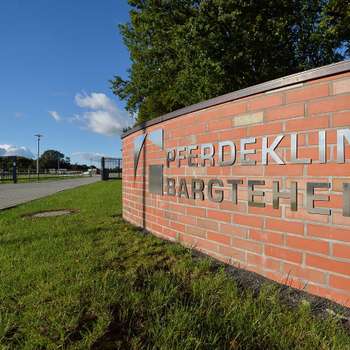
Pferdeklinik Bargteheide
Practice in Alte Landstraße 104, 22941 Bargteheide, Germany
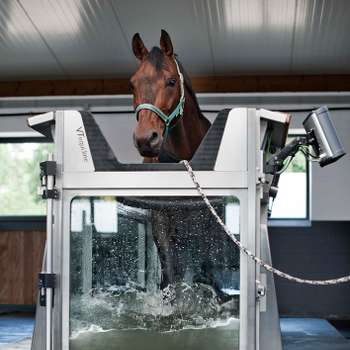
For over 30 years, Pferdeklinik Bargteheide has been established as an interregional referral clinic and is counted among Germany's leading equine hospitals. As an independent, owner-managed clinic, it makes its medical decisions solely in the interest of the horse. The extensive grounds feature 72 stables, spacious facilities, and modern diagnostics ranging from X-ray, CT, and MRI to scintigraphy – much of it performed on the standing, sedated horse. More than 70 team members in veterinary medicine, service, stables, and grounds work hand in hand to ensure that every horse feels cared for in the best possible way.
Treated animals
Large & Farm Animals
- horses
Medical focus areas and specializations
- anesthesia
- chiropractic & osteopathy
- CT
- dentistry
- endoscopy
- internal medicine
- laser therapy
- MRI
- ophthalmology
- orthopedics
- pre-purchase examination
- surgery
- ultrasound
- x-ray
Services
- HospitalizationOvernight or multi-day monitoring and care
Opening hours
- Monday
- 8:00 AM–6:30 PM
- Tuesday
- 8:00 AM–6:30 PM
- Wednesday
- 8:00 AM–6:30 PM
- Thursday
- 8:00 AM–6:30 PM
- Friday
- 8:00 AM–6:30 PM
- Saturday
- 9:00 AM–11:00 AM
- Sunday
- 9:00 AM–11:00 AM
Emergencies
Spoken languages
- 🇩🇪 German
Contact
- Website
- Email
- Phone
- Fax
- Facebook
- Instagram
- YouTube
Practice location
Pferdeklinik Bargteheide
Practice location
Alte Landstraße 104
22941 Bargteheide
Germany
Team 77
Dr. Jan C. Brunk
Clinic Director
Dr. Ina Lorenz
Clinic Director
Dr. Volker Sill
Clinic Director
Lisa Bodem
Veterinarian
Dr. Svenja Ehlers
Veterinarian
Dr. Johanna Giers
Veterinarian
Dr. Gesche Höncher
Veterinarian
Dr. Friederike Jaek-Lutz
Veterinarian
Emilia Konieczna
Veterinarian
Pia Liebal
Veterinarian
Sophia Mues
Veterinarian
Gesche Nohl
Veterinarian
Anika Parthey
Veterinarian
Lea Peters
Veterinarian
Ella Roga
Veterinarian
Dr. Sahra Sielaff
Veterinarian
Dr. Klaas-Ole Blohm
Consulting Veterinarian
Dr. Werner Jahn
Consulting Veterinarian
Josefine Büth
Veterinary Assistant
Lotta Demski
Veterinary Assistant
Laura Detert
Veterinary Assistant
Luise Drapala
Veterinary Assistant
Annika Fischer
Veterinary Assistant
Sarah Groth
Veterinary Assistant
Alex Köpke
Veterinary Assistant
Neele Krünkelfeld
Veterinary Assistant
Helene Raben von Kügelgen
Veterinary Assistant
Jil Leonhart
Veterinary Assistant
Janine Loeck
Veterinary Assistant
Sarah Rauhut
Veterinary Assistant
Lina Scholmeyer
Veterinary Assistant
Angelina Stölting
Veterinary Assistant
Frederike Töpfer
Veterinary Assistant
Alina Ueberholz
Veterinary Assistant
Emma Behn
Trainee
Lara Bernhard
Trainee
Jolina Beusen
Trainee
Emilia Bode
Trainee
Momme Brügge
Trainee
Antonia Erbarth
Trainee
Mila Galle
Trainee
Lara Grest
Trainee
Kaja Hoegen
Trainee
Lecilia Hofer
Trainee
Nika Künzel
Trainee
Lene Martins
Trainee
Jesper Meyer
Trainee
Kaja Motzkus
Trainee
Lotta Müller-Lupp
Trainee
Sofie Otto
Trainee
Alyssa Pothmann
Trainee
Lina Remer
Trainee
Nina Riedel
Trainee
Janna Schiemann
Trainee
Beeke Schlieker
Trainee
Jalina Schliephake
Trainee
Philippa Süßmann
Trainee
Leonie Sutor
Trainee
Ann-Kathrin Büchner
Service & Office
Nina Falkenhayn
Service & Office
Nina Hüttinger
Service & Office
Stefanie Lanz
Service & Office
Wiltrud Manke
Service & Office
Sarah May
Service & Office
Victor Rogall
Service & Office
Marie-Therese Schmidt
Service & Office
Anne Trabert
Service & Office
Claudia Wiese
Service & Office
Sandra Wolf
Service & Office
Andreas Baasch
Stables & Grounds
Judith Becker
Stables & Grounds
Claudia Jarstorf
Stables & Grounds
Stefanie Kotschi
Stables & Grounds
Arno Lindemann
Stables & Grounds
Matthias Meloun
Stables & Grounds
Andrea Müller
Stables & Grounds
Heiko Witten
Stables & Grounds
Reviews
Frequently asked questions
Yes, both procedures can be performed on the standing, sedated horse. For CT, this allows the head, parts of the cervical spine, and the lower limbs to be imaged, while for MRI, the area from the hoof up to the fetlock or hock joint can be examined. General anesthesia is required for the upper limbs and the rear sections of the cervical spine.
Especially in cases of unclear or severe lameness, as well as suspected changes in hard-to-reach regions such as the pelvis, hip, or femur. Scintigraphy often reveals foci of inflammation and bone metabolism disorders before they show up on an X-ray, and it is performed on the standing, sedated horse.
If resting endoscopy does not provide sufficient findings, dynamic endoscopy can help. During this procedure, the larynx and pharynx are filmed on the longe line or under a rider, allowing workload-dependent changes such as dorsal displacement of the soft palate or pharyngeal collapse to be assessed more reliably.
The horse should not have any food for at least 15 hours and no water for about four hours beforehand so that the stomach empties and the mucosa is fully visible.
Yes. Alongside examinations of the anterior and posterior segments of the eye and ocular ultrasound, corneal injuries and defects are treated conservatively, if necessary via a subpalpebral lavage catheter. Immune-mediated keratitis, recurrent uveitis, and glaucoma are also treated, surgically as well depending on severity.
Veterinary practices nearby

Are you the owner or a team member of this practice? Claim this profile to manage it yourself.