Bloat in Dogs: The Early Signs of GDV Every Deep-Chested Breed Owner Must Know
A guide to spotting the earliest signs of bloat (GDV) in dogs, which breeds are most at risk, and why immediate emergency care is the only right response.
- dogs
- surgery
- internal medicine
- nutrition counseling
- Pale Gums
- Feeding Schedule
·
Key takeaways
- Watch for restlessness that will not settle, especially after meals
- Unproductive retching with nothing coming up is a red flag, not an upset stomach
- A drum-tight swollen belly, pale gums, or collapse mean go straight to the vet
- Feed smaller meals, slow down a gulper, and skip the raised bowl
- Keep hard exercise away from mealtimes
- Ask your vet about a preventive gastropexy if you own a high-risk breed
If you share your home with a Great Dane, a German Shepherd, a Weimaraner, or any dog built with a long, narrow chest, read this before you ever need it. Gastric dilatation-volvulus, known as GDV or simply bloat, is one of the fastest-moving emergencies in veterinary medicine, and spotting the signs of bloat in dogs early can decide whether your dog lives. This is not a wait-and-see problem. It is a get-in-the-car problem.
What exactly is GDV, and why the panic?
Bloat starts simply: the stomach fills with gas, fluid or food and swells. That stage is called gastric dilatation. The danger comes when the swollen stomach rotates on itself. It can turn anywhere from a quarter turn to a full circle, and once the rotation passes about 180 degrees the lower end of the food pipe is sealed off, so the dog can no longer belch or vomit the gas away. Pressure builds with nowhere to go.
From there the damage spreads well beyond the stomach. The ballooning stomach presses on the large veins that carry blood back to the heart, blood pressure falls, and the dog slides into shock. It also pushes forward against the diaphragm, so breathing becomes harder. Because the spleen sits attached to the stomach, it often twists along with it, which can cause serious internal bleeding, and the stomach wall itself can lose its blood supply and start to die. Cornell University's canine health centre describes how this combination of low oxygen delivery and falling cardiac output also triggers abnormal heart rhythms.
Even with proper treatment, roughly one in five treated dogs does not survive, and the odds get worse the longer the stomach stays twisted. The American Animal Hospital Association is blunt about the timescale: bloat can go from mild-looking discomfort to a life-threatening crisis within hours, sometimes minutes, and there is no home treatment that works. No massage, no walking it off, no waiting for it to pass.
What are the earliest signs of bloat in dogs?
This is the part owners most often miss, because the first symptoms look like a dog who is simply unsettled rather than critically ill. Watch for:
- Restlessness that will not resolve: Your dog paces, lies down, gets up, circles, and repeats, unable to settle anywhere.
- Unproductive retching: He heaves and brings up nothing, or only a little foam or saliva. Repeated retching with no vomit is one of the most telling signs and should not be brushed off as an upset stomach.
- Heavy drooling: Sudden salivation happens because a dog with a twisted stomach cannot swallow or bring anything up.
- Looking at or worrying about the belly: Some dogs stare at their own abdomen, stand and stretch repeatedly, or arch the back as if trying to relieve pressure.
- The "praying" position: Front legs stretched forward with the chest lowered towards the floor is a classic sign of abdominal pain in this situation.
- Panting or an anxious expression: A dog who is normally calm after dinner suddenly cannot lie still and looks distressed for no obvious reason.
These signs often appear in the hours after a large meal, but bloat can also strike at other times. A dog in the early stage may still seem interested in food or water, which lulls owners into thinking it is nothing. If your deep-chested dog is restless and retching without producing anything, treat it as an emergency now rather than watching to see whether it gets worse.
How do symptoms progress if it is bloat?
Once dilatation tips into a twist, things move quickly. Look for this second wave:
- A swollen, drum-tight belly: Most obvious behind the ribs. In heavily muscled, very hairy or overweight dogs, a distended stomach can be genuinely hard to see or feel, so a normal-looking belly does not rule bloat out.
- Pale, white or grey gums: A sign that blood is not circulating properly.
- Fast or laboured breathing: The swollen stomach limits how far the lungs can expand.
- A racing, weak or irregular pulse: Heart rhythm problems are common as shock develops.
- Weakness or collapse: In advanced cases the dog cannot stand at all.
You do not need the full list to act. Restlessness plus unproductive retching is already enough reason to phone an emergency vet and set off.
Which breeds are most at risk?
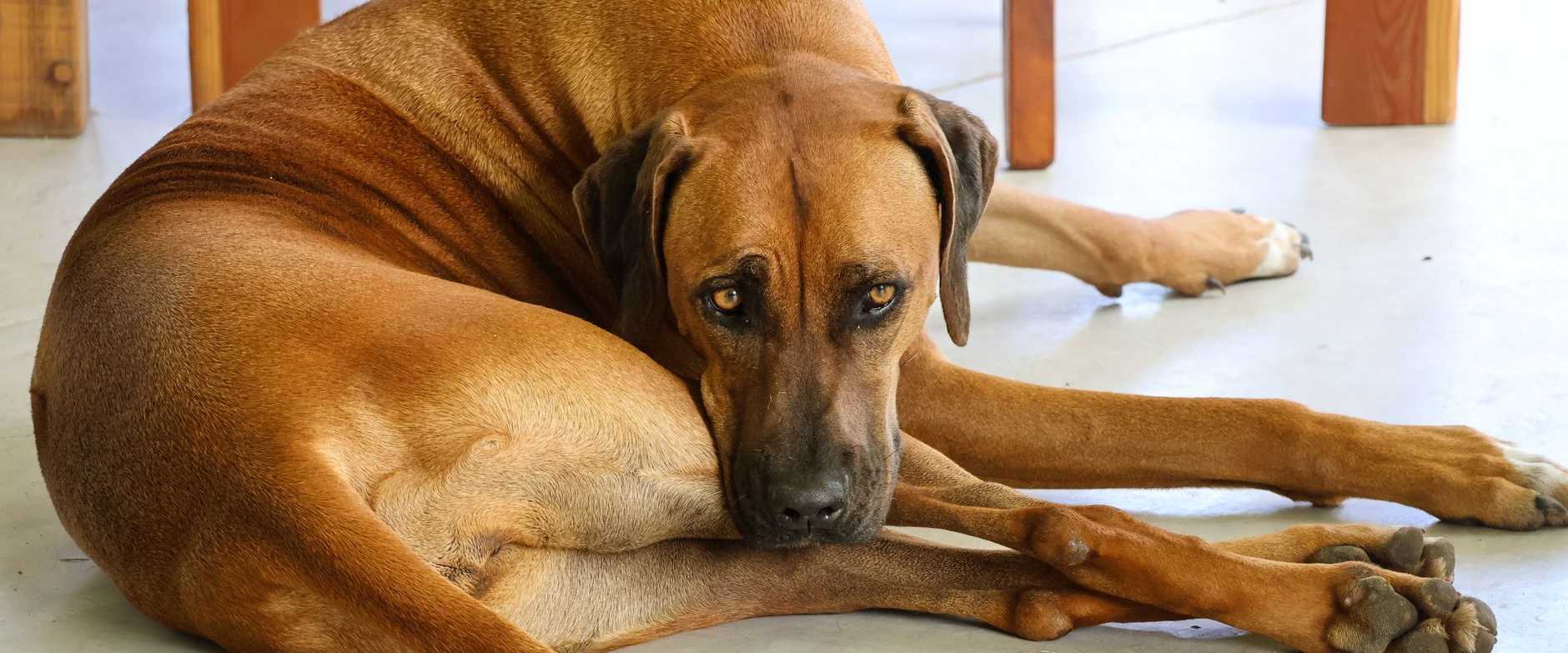
Body shape matters more than the breed name. Dogs with a chest that is deep from top to bottom but narrow from side to side have more room behind the ribcage for the stomach to move and rotate. Researchers measure this as the chest depth-to-width ratio, and the higher that ratio, the higher the risk. The same work put the Great Dane at the top of every list, with an average lifetime chance of a bloat episode of about 42 percent.
Breeds that appear consistently on risk lists include Great Danes, German Shepherds, Weimaraners, Saint Bernards, Irish and Gordon Setters, Standard Poodles, Doberman Pinschers, Bloodhounds, Irish Wolfhounds, Akitas, Boxers and Basset Hounds. Large mixed-breed dogs with that same deep, narrow build turn up frequently in hospital caseloads too, so a crossbreed is not exempt.
Two caveats. Basset Hounds carry a high risk despite not being a large breed, and bloat has occasionally been reported in small dogs and even in cats, so a shallow chest lowers the risk without erasing it. Most cases, though, are middle-aged to older dogs of the classic large and giant deep-chested types.
What else raises the risk beyond breed?
- Eating fast or eating one big meal a day: Dogs that gulp their food have a measurably higher risk, and once-daily feeding of a large volume adds to it.
- Age: Risk climbs steadily with age, and the increase is steep: about 20 percent more per year after age five in large breeds, and after age three in giant breeds.
- A lean build: Thin dogs are at higher risk than heavier ones, probably because abdominal fat takes up space the stomach would otherwise move in. This is not a reason to let a dog gain weight, since obesity brings its own problems.
- A nervous or fearful temperament: Anxious, fearful and aggressive dogs appear to bloat more often than calm ones.
- Family history: Having a parent, sibling or offspring who has bloated raises an individual dog's risk by roughly 63 percent, which is why breeders and vets take family history seriously.
- Exercise close to mealtimes: Hard activity soon before or after eating is on most risk lists.
- Diet composition: Dry foods that list an oil or fat among the first four ingredients have been linked to higher risk in dogs already predisposed.
- Raised food bowls: Older advice recommended them. A large prospective study from Purdue University found the opposite, estimating that raised bowls accounted for about 20 percent of cases in large breeds and 52 percent in giant breeds. Feed at floor level unless your vet has advised a raised bowl for a separate reason.
When should you call the vet?
Call an emergency vet immediately, before you finish reading this list, if your dog shows:
- Pacing or restlessness that will not settle, especially after eating
- Retching or dry heaving with nothing coming up
- A swollen, tight or drum-like belly
- Heavy drooling with obvious distress
- Pale, white or grey gums
- Fast or laboured breathing
- Weakness, wobbling or collapse
Phone the clinic while someone else drives so the team can prepare. Do not offer food or water, do not try to make your dog vomit, and do not give any medication at home. Where you go matters more than what you do: bloat needs surgery in most cases, so head for a clinic equipped for emergency surgery if you have the choice. Availability of out-of-hours emergency care differs a lot between countries and even between towns, so it is worth knowing tonight where your nearest option is.
What happens once you get there?
The team will treat shock first, with intravenous fluids through large catheters, pain relief and other medications, while taking blood and often running an ECG to check the heart rhythm. Blood lactate is frequently measured because it helps gauge how badly the tissues are suffering, though it is used to guide conversation rather than to predict any individual dog's outcome. The stomach is then decompressed, either with a needle passed through the body wall into the stomach or with a tube passed down from the mouth, which does not always get past the twist.
X-rays help separate simple dilatation from a true twist. They are good at spotting the usual half-turn, where the stomach appears divided into two gas pockets on the film, but much less reliable when the stomach has rotated a full 360 degrees, which can look almost identical to plain bloat. That is why your vet may recommend surgery based on the whole picture rather than the X-ray alone, particularly if the stomach refills with gas after decompression.
Surgery untwists the stomach, checks the stomach wall and spleen, removes any tissue that has died, and finishes with a gastropexy, tacking the stomach to the body wall so it cannot rotate again. Stabilising the dog properly before anaesthesia is part of the treatment, not a delay: in one study of 162 dogs, 80 percent survived to discharge, with no difference between dogs operated on quickly and those stabilised for longer first.
Is preventive gastropexy worth discussing?
For a high-risk breed, yes, and the conversation is best had while your dog is healthy. The American College of Veterinary Surgeons estimates that GDV occurs in about one in five at-risk dogs that do not have a preventive gastropexy, and the procedure can often be done laparoscopically through two or three incisions under about 4 cm, which means less pain and a faster recovery than open surgery. Either way, expect roughly ten days to two weeks of strict rest afterwards, with a cone to protect the incision.
The safety record is reassuring. In a review of 766 dogs that had a preventive gastropexy, only three had a complication at the surgical site, and none of those followed long-term went on to develop bloat. Modelling studies suggest the reduction in death from GDV is largest in the highest-risk breeds, close to thirty-fold in Great Danes and much smaller in breeds with lower baseline risk, which is exactly why the decision should be made breed by breed and dog by dog with your own vet. It is commonly timed to coincide with neutering or another planned abdominal procedure.
The takeaway
Bloat rewards speed. The earliest signs, restlessness that will not settle and retching that brings nothing up, are the easiest to dismiss and the most valuable to catch. Feed smaller meals rather than one large one, slow down a gulper, skip the raised bowl, keep hard exercise away from mealtimes, and if you own a breed near the top of the risk list, ask your vet about a preventive gastropexy. If bloat does start, there is only one right move, and it is the fastest one: straight to a vet, no delay.