Tierärztliche Praxis für Chiropraktik Annkatrin Schäfer
Practice in Onstmettinger Straße 45, 72406 Bisingen, Germany
House calls across the Reutlingen, Albstadt, Rottenburg am Neckar area


Annkatrin Schäfer is a veterinarian providing chiropractic care for horses and dogs -- on the road in the animals' familiar surroundings, throughout the Zollernalb, Tübingen, and Reutlingen districts, as well as in Herrenberg and Horb. Trained at the IAVC in Sittensen, she views each animal as a whole: a case history discussion is followed by evaluation at rest and in motion, as well as a palpation exam, before the spine and limbs are treated with short, precise impulses. The goal is to release movement restrictions and the resulting compensation patterns and to maintain or restore natural mobility -- as a complement to conventional veterinary care, not a replacement. Treatment is also provided preventively, for older animals as well as those in training or growing, and first-aid courses are available for dog clubs.
Treated animals
Small Animals & Pets
- dogs
Large & Farm Animals
- horses
Medical focus areas and specializations
- chiropractic & osteopathy
Appointments & new clients
Spoken languages
- 🇩🇪 German
Contact
- Website
- Email
- Phone
Practice location and mobile service area
Tierärztliche Praxis für Chiropraktik Annkatrin Schäfer
Practice location
Onstmettinger Straße 45
72406 Bisingen
Germany
House calls
Reutlingen, Albstadt, Rottenburg am Neckar
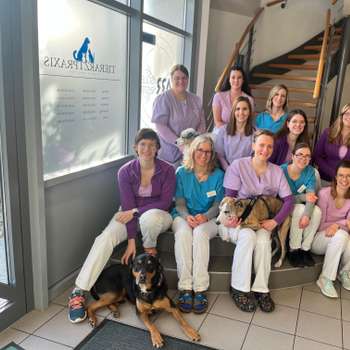
Team 1
Reviews
Although veterinarian Annkatrin Schäfer's practice is temporarily closed, I received a call back after leaving a message on her answering machine. I'm not usually one to write reviews, but I absolutely wanted to leave one here. Ms. Schäfer provided me with very thorough and highly competent advice, even for a layperson, explaining my situation in a way that was easy to understand. She outlined the various treatment options available to me (it involved a dislocated hip). Ms. Schäfer was very empathetic, friendly, and helpful. Thank you so much, and I will gladly recommend her. A. Knoblauch
Our Icelandic mare is very grateful! She's much, much more mobile since the treatment! Ms. Schäfer took a lot of time for our horse and our questions!
👍🏼
Ms. Schäfer Koslowski is currently treating our Irish Wolfhound. We are very satisfied. He has become more mobile and agile again. Ms. Schäfer Koslowski has a very empathetic manner.
Ms. Schäfer gave me a very thorough consultation over the phone. Since his surgery, my cat has been having trouble sitting, and I was very worried. Although I live about 100 km away and she unfortunately couldn't come in person, she took plenty of time and explained everything clearly. This competent and empathetic telephone consultation absolutely deserves 5 stars. Thank you so much for your wonderful support!
Frequently asked questions
Yes, the practice is mobile and treats animals in their familiar environment, covering the Zollernalb, Tübingen, and Reutlingen districts, as well as Herrenberg and Horb. For a horse, a spot with level ground should be available.
First, you share how your animal lives and what symptoms you have noticed during the case history discussion. Then the animal is evaluated while standing and moving, followed by a palpation examination of the musculature. Treatment is usually carried out from the pelvis up the spine to the head, and finally the limbs.
No. An adjustment is a short, controlled impulse applied at the correct angle of the joint surfaces and within the physiological range of motion. This engages the stretch receptors of the joint capsules and surrounding musculature, which send their signals via the spinal cord to the brain.
A horse should be walked for about 20 to 30 minutes afterward; intensive training is not advisable on the following one to two days, though moderate movement on the longe line or under saddle is fine. A dog should not be allowed to romp around wildly right after the treatment.
Some animals drink and urinate more frequently, yawn, or sweat. They often show muscle soreness for one to two days and move more stiffly as the body adjusts to the new situation. A previously hidden lameness may also become more apparent once the compensatory posture is gone -- which points to the actual cause.
No. Acute lameness, suspected fractures, slipped discs, or abscesses must be seen by your regular attending veterinarian first. Chiropractic care complements conventional veterinary medicine, for instance after surgeries and injuries, and prevents compensatory blockages caused by existing immobility.
Veterinary practices nearby


Are you the owner or a team member of this practice? Claim this profile to manage it yourself.