Thunderstorm and Fireworks Anxiety in Dogs: How to Calm a Noise-Phobic Dog
A practical guide to recognising noise phobia in dogs and managing thunderstorm or fireworks fear with safe spaces, comfort, training and veterinary treatment options.
- dogs
- behavioral science
- internal medicine
- general medicine
- Firework Fear
- Fear & Phobias
- Compulsive Behavior
- Microchipping
·
Key takeaways
- Set up a safe den in a quiet, central room weeks before firework season
- Stay home and comfort your dog during storms and fireworks instead of ignoring them
- Feed high-value treats after every bang to build positive associations
- Lock windows, doors and gates, and check ID tags and microchips before the event
- Ask your vet about a medication plan well before the next known noisy event
- Rule out pain or hearing loss if fear appears suddenly in an adult or older dog
If your dog is scared of thunderstorms or fireworks, you already know the pattern: the pacing, the panting, the frantic digging behind the sofa, the drooling on your feet at 11pm on New Year's Eve. Noise fear is one of the most common behaviour problems in dogs. In a survey of more than 5,000 dogs from 17 breeds, about one in five owners reported strong or very strong fear of fireworks, and roughly one in ten said the same about thunderstorms. Yet only a small minority of owners ever ask a professional for help. That is a shame, because thunderstorm and fireworks anxiety responds well to treatment, and there is plenty you can do this week, this season, and over the coming year.
How do I know my dog has noise phobia and not just a startle?
A dog who flinches at a bang and then goes back to chewing their toy is fine. Noise phobia is different: the fear is out of proportion to any real danger, it persists after the sound has stopped, and it can even appear in anticipation, before a single bang, when your dog senses that something is coming.
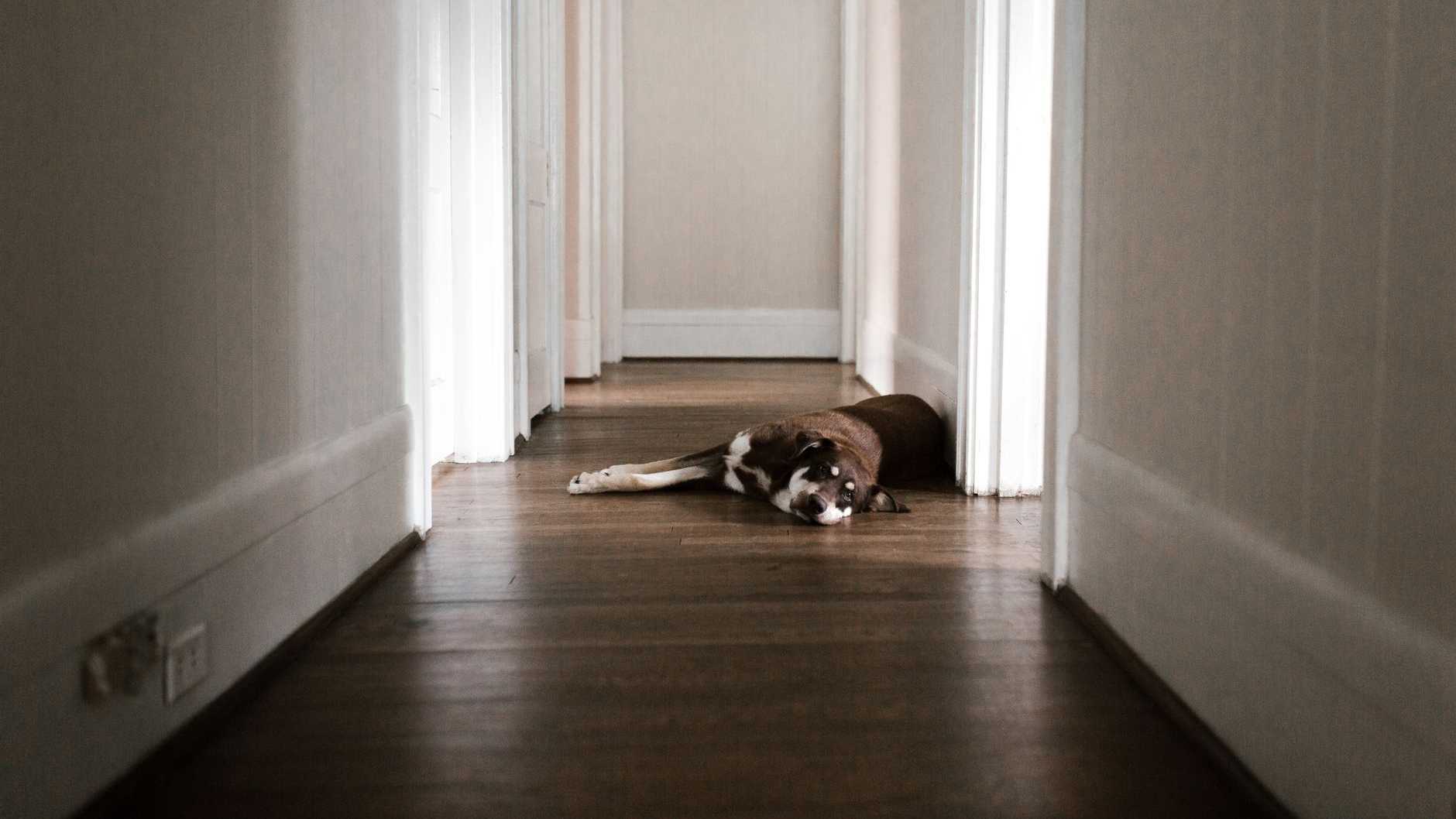
Fear signs fall into two rough groups. Some dogs go quiet and still, which is easy to miss:
- trembling, shaking or freezing
- hiding under furniture, in bathrooms, behind the toilet
- heavy panting and drooling
- refusing food they normally love
- withdrawal, or the opposite, glueing themselves to you room to room
Others go into overdrive:
- barking, whining, howling
- restlessness, pacing, an exaggerated startle at every noise
- scratching or chewing at windows, crates and door frames
- bolting out of gardens or open doors
- urinating or defecating indoors, sometimes vomiting
- in severe cases, self-injury during escape attempts
Both patterns matter equally. A dog who shuts down and hides is not necessarily less frightened than one who tries to dig through the floor.
Why is my dog suddenly scared of thunderstorms?
Noise fear comes from a mix of inherited temperament and life experience. Breed, sex and age all shift the risk, which tells us genes play a real part, but so does every bad night your dog has already lived through. Left alone, these problems tend to worsen over time and spread, so a dog who once only feared fireworks may start reacting to slammed doors, then to the room or the time of day when the fireworks usually happen. European veterinary behaviour specialists describe this as a shift from a dog who can still cope and hide, to one whose coping strategies fail altogether.
One cause is easy to overlook: pain. Behaviourists at the University of Lincoln compared noise-sensitive dogs with and without musculoskeletal pain. In the painful dogs, the noise fear had begun on average nearly four years later in life and had generalised far more widely to other places and situations. The likely explanation is that a startle jolts an already sore body, so the sound becomes linked to a flash of pain. Encouragingly, those dogs did well once the pain was treated alongside the behaviour work.
So if your seven-year-old Labrador who never cared about storms suddenly hides from them, book a check-up rather than assuming it is "just" behaviour. Before treating a noise phobia as purely behavioural, vets are advised to rule out medical causes such as partial deafness in the upper range, failing sight, pain, dementia and other age-related changes, thyroid disease, and hormonal conditions. Some steroid medication can also increase sensitivity to noise.
What should I do during fireworks or a thunderstorm?
Set up the safe space before the season starts
The most useful thing you can build is a den your dog chooses voluntarily.
- Pick the quietest, most central room. Reducing what your dog sees and hears helps, so close the blinds, use a room without windows and add background sound from a fan or music
- Put a covered crate with the door left open, or a bed under a table with blankets over the sides. Never shut a panicking dog in
- Add their own bedding plus something that smells of you, such as a worn t-shirt
- Keep the background noise at a normal volume. You are not trying to drown out a bang, just blur its sudden edge
- In warm weather, keep the room ventilated and offer water
- Let your dog use the space on calm days for weeks beforehand, with treats and chews, so it already means good things
On the night itself
- Walk and toilet your dog early, in daylight, well before the fireworks or the forecast storm.
- Feed a normal or slightly early meal. Most dogs will not eat once they are frightened.
- Close and lock windows, doors, gates and cat flaps. A terrified dog can break through a door or window trying to escape, and dogs go missing this way every firework season, so check the ID tag and microchip details in advance too.
- If you must go outside, use a lead and harness even in a fenced garden.
- Stay home if you can. Noise fear and distress at being left alone often travel together, so your absence can stack a second fear on top of the first. If you cannot be there, arrange a sitter your dog knows well. Our guide to rebuilding your dog's tolerance for time alone may help if that is part of the picture.
- Give any prescribed medication in good time, before the fear starts. Preventing panic is much easier than reversing it.
- Hand over something excellent after each bang: cheese, chicken, liver paste. When owners were asked what actually helps, offering valuable food or play during the noise, relaxation techniques and medication came out on top.
- If your dog can still eat, chew or play, keep going. If they cannot, do not push it.
- Never scold, shout, or drag your dog out of hiding, and never force them to face the sound. Punishment makes fear worse.
Should I comfort my dog or ignore the fear?
Comfort them. The old advice to ignore a frightened dog is not supported by behaviour specialists, who describe ignoring a fearful animal as inappropriate. Fear is an emotion, not a trick your dog performs for attention.
What matters is the kind of comfort. Be the calm one in the room: sit with them, breathe slowly, speak in a low even voice, stroke them in long slow strokes if they lean in. Your dog reads your body language, so anxious hovering and high-pitched fussing do not help. If you have already taught a settle or a "go to your mat" cue, asking for that trained behaviour gives your dog something to do instead of panicking. And if they would rather be alone in the bathtub than on your lap, let them.
Do calming vests, pheromones and supplements work?
They can take the edge off for mildly affected dogs and are reasonable additions to a plan. They are not treatments for a true phobia on their own.
For dog-appeasing pheromones, a review of eight controlled trials found the overall evidence weak, with moderate evidence that pheromones can reduce some fear behaviours triggered by thunderstorm noise. The authors' practical conclusion is sensible: pheromones are unlikely to do harm and may help as part of a wider plan, but they should not take the place of treatments with established effects.
Supplements are a mixed picture. A placebo-controlled trial in 44 firework-fearful dogs tested a tryptophan, valerian and passionflower combination alongside standard environmental advice, and found a greater fall in owner-rated fear and a smaller stress hormone rise over New Year's Eve. It was a small study with industry involvement, so treat it as promising rather than settled. Pressure wraps are also worth trying for mild cases.
Practical read: start a diffuser or a snug wrap a few days early if you like, but do not build the whole plan around them. Be wary of unregulated "calming" products bought online, especially alongside prescription medicines.
When is medication for noise phobia warranted?
Medication is appropriate when your dog is genuinely panicking, when they risk hurting themselves, or when the fear is severe enough that they cannot eat, settle or learn. Waiting out another summer of trembling under the bed is not the kinder option. Speak to your vet well before a known event, and ask whether a trial dose on a quiet day makes sense so you know how your individual dog responds.
Options your vet may discuss:
- Dexmedetomidine oromucosal gel: in a New Year's Eve trial of 182 dogs, owners rated the effect good or excellent in 72 per cent of treated dogs compared with 37 per cent on placebo, with fewer signs of fear and no sedation. It goes into the cheek pouch, not down the throat, ideally 30 to 60 minutes before the noise, with at least two hours between doses. It is meant for otherwise healthy dogs, and is not suitable for dogs with heart disease, kidney disease, breathing problems, exhaustion or heat stress
- Imepitoin: licensed in some regions for situational noise fear. To work, it has to be started two days before the event and continued on the day. A trial in 238 firework-fearful dogs showed a significant benefit, but wobbliness on the legs occurred in more than 20 per cent of treated dogs, and half of those took two or more days to recover
- Short-acting anxiolytics such as benzodiazepines or trazodone: used situationally, sometimes in combination. They must be given before the event rather than during it, and by lifting anxiety and appetite they can make food-based counter-conditioning possible again
- Daily medication such as an SSRI: considered for dogs who are anxious in many situations or year round. These work over weeks and months, alongside behaviour training, and aim to stop the phobia generalising further
- Acepromazine: an old sedative that behaviour specialists now consider inappropriate for noise fear. It flattens the dog's ability to react without relieving the fear, may increase sound sensitivity, and has been linked to disorientation and disinhibited aggression
Availability and licensing differ from country to country, so your vet will know what is an option where you live. Never give your dog human anxiety medication, leftover prescriptions or another animal's tablets. Serious harm can follow from medicating a pet without veterinary advice.
How do I reduce the fear long term?
Management gets you through the night. Training changes how your dog feels about the sound.
- Desensitisation and counter-conditioning: play a good recording of thunder or fireworks so quietly your dog barely notices, pair it with food or play, and build up in tiny steps. The guidance from the Merck Veterinary Manual is worth following closely: your dog must stay calm throughout, short frequent sessions beat long rare ones, and you should vary the volume up as well as down rather than climbing steadily. If your dog reacts, stop, let them settle, and go back to an easier level
- Relaxation training: teach a settle on a mat in quiet conditions first, so the behaviour is solid before you need it
- Treat after any random bang all year: a slammed door, a passing motorbike. It builds resilience instead of sensitivity
- Puppies: introduce a wide range of everyday sounds gently and positively, always followed by something good. Prevention is far easier than treatment
- Get help early: a vet with behaviour experience, or a veterinary behaviourist, can combine medication with a training plan. Improvement is usually measured in months, not days
There is one quietly encouraging finding here. When dogs with noise aversion were treated across a series of noise events, the likelihood of needing medication fell with each subsequent event. Treating the panic does not create dependence, it gives the dog room to learn.
When to call the vet
Contact your vet the same day, or an emergency service out of hours, if your dog:
- has injured themselves: bleeding paws, broken nails, damaged teeth, or wounds from chewing at doors and crates
- has escaped and been hit by a car, or is missing after bolting
- collapses, has a seizure, or seems disoriented
- is still panicking, trembling or unable to settle hours after the noise has stopped
- has been panting hard in a hot room, feels overheated or seems weak, in which case treat it as a possible heat emergency
- may have swallowed something during the panic, such as fabric, plastic or splinters of a crate
- has not eaten or drunk for more than 24 hours, or is vomiting repeatedly
- has been aggressive out of fear towards a person or another pet
Book a non-urgent appointment if the noise fear is new in an adult or older dog, if it is worse every season, or if your current plan clearly is not enough. New or rapidly worsening noise fear deserves a physical exam, including a check for pain and hearing, before anyone assumes it is purely behavioural.
The bottom line
Noise phobia is a genuine welfare problem, and dogs rarely grow out of it on their own. Build the den now, muffle the sound, stay with your dog, feed something wonderful after every bang, and arrange a medication plan before the next big night rather than during it. Then use the quiet months for slow, patient sound training. Most dogs improve a great deal with that combination, and the ones who need medication are usually far happier for having it.
This guide is general information and does not replace an individual assessment. Any medication decision belongs with your own vet, who knows your dog's health history.