My Cat Has Suddenly Turned Aggressive Toward Me: Causes, Safe Handling and How to Fix It
Why a cat may suddenly become aggressive toward its owner, from hidden pain to redirected aggression, plus how to stay safe, when to see the vet and what helps.
- cats
- behavioral science
- general medicine
- Enrichment
- Fear & Phobias
·
Key takeaways
- Book a vet check first, since hidden pain or illness is a common cause
- Learn the warning signs: flattened ears, twitching tail, stiff stare
- Back away calmly and never punish, shout at or chase your cat
- Give an upset cat a quiet room with food, water, litter and a hiding place
- Wash any bite or deep scratch and get medical advice promptly
- Keep a diary of triggers and film episodes to show your vet
- Use wand toys, never hands, and stop petting before your cat objects
If your cat has suddenly become aggressive toward you, hissing, swatting or biting when they never used to, it is upsetting and often frightening. This guide is for owners trying to work out why it is happening, how to stay safe in the meantime, and what actually helps. The short version: a sudden change in behaviour is a reason to see your vet, because hidden pain or illness is a common and very treatable cause.
Why is my cat suddenly aggressive toward me?
Cats rarely become aggressive for no reason. Something has changed, either in their body, in their environment, or in how they feel about a particular situation. Broadly, the causes fall into two groups: medical problems and behavioural triggers. Often both are involved.
Could my cat be ill or in pain?
This is the first question to answer, and the reason a vet visit comes before any behaviour plan. Cornell's Feline Health Center lists hyperthyroidism (an overactive thyroid gland), osteoarthritis, dental disease and problems in the brain or nervous system as conditions that can cause aggression in cats.
Pain deserves special mention. Cats are good at hiding it, and a change in behaviour is often the main or only outward sign. Behaviour specialists reviewing their own referral cases found that pain was involved in somewhere between 28% and 82% of problem behaviour cases, and they concluded that suspected pain should be treated first rather than considered only after behaviour training fails.
Other medical causes that can show up as irritability or aggression, according to the MSD Veterinary Manual, include:
- Hyperthyroidism, which may also bring night waking, restlessness and increased activity
- Failing eyesight or hearing, which can leave a cat startled and confused
- Nerve pain, which may cause over-sensitivity to touch
- Certain types of seizure, which can cause brief spells of fear or aggression, staring or chomping
- Liver or kidney disease affecting the brain
- Disease of the brain itself, which may also cause disorientation or loss of house training
If dental pain is on your mind, our guide to feline dental disease and bad breath explains how often mouth problems go unnoticed.
What behavioural reasons make a cat attack its owner?
Once illness has been ruled out, the type of aggression points the way to the fix. A review of owner-directed aggression in cats ranks misdirected play and petting-related aggression as very common, and fear-related and redirected aggression as common. The same review notes that most cases reflect underlying stress, and that indoor-only cats and cats in single-cat homes appear more prone to the problem.
Redirected aggression: This is the one that most often looks "sudden". Your cat becomes highly worked up by something they cannot reach, then turns on the nearest target. In one study of cats with redirected aggression, loud noises or encounters with other cats triggered 95% of incidents, and the owner was the most common victim. The cats usually looked defensive just beforehand, which suggests fear was driving it. Other triggers reported include visitors, dogs, unusual smells and a cat seeing another cat outdoors.
Fear-related aggression: A frightened cat that cannot escape may lash out to protect itself. Handling, restraint, nail trims and vet visits are classic situations.
Petting-related aggression: Your cat seeks you out, enjoys a few strokes, then bites or swats. Wanting to be near you is not the same as wanting to be stroked, or stroked in that spot, or for that long.
Play or predatory aggression: Ambushing ankles, pouncing on moving feet, or rough biting during play. This is common in young cats and in cats that were played with using hands.
How can I tell my cat is about to attack?
Learning your cat's warning signals is the single most useful safety skill you can build. The ASPCA describes two main postures:
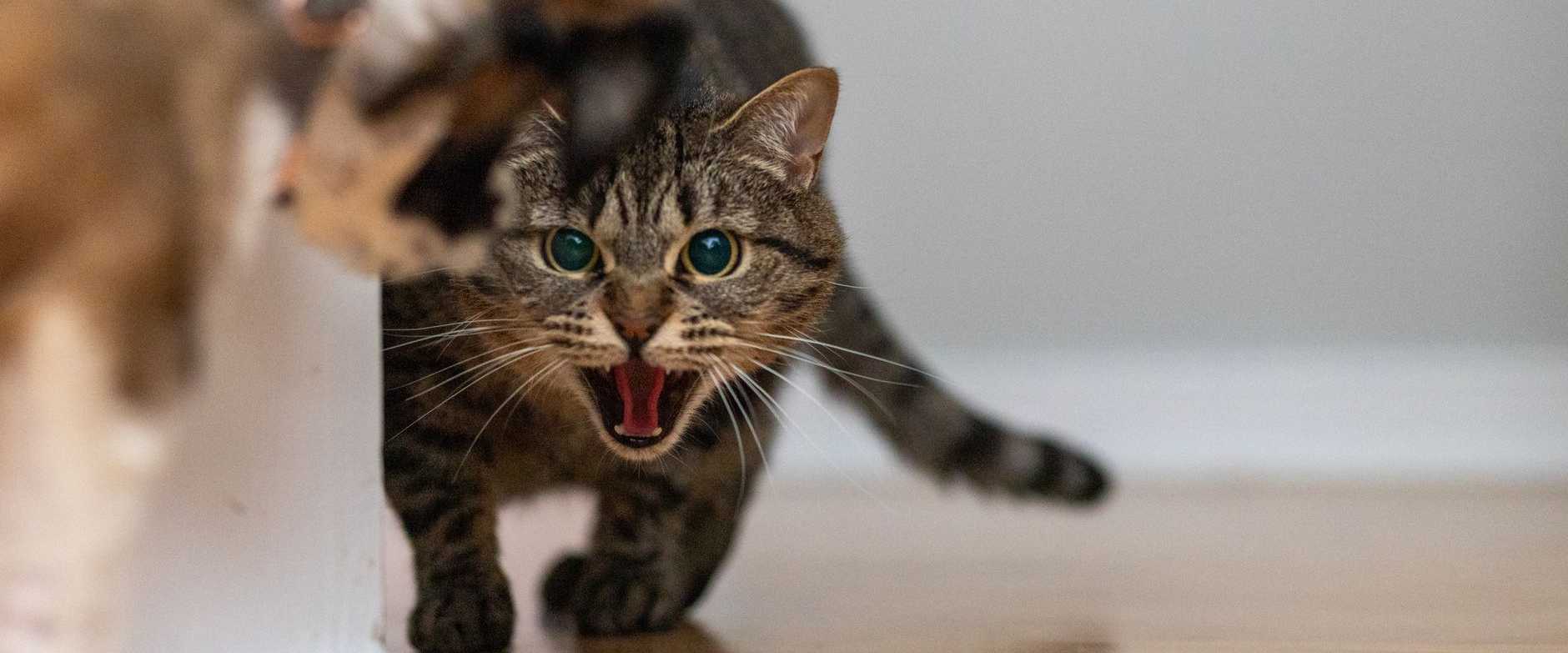
A defensive, frightened cat tries to look smaller:
- Crouching with the head tucked in
- Tail wrapped around or tucked under the body
- Wide eyes with large pupils
- Ears flattened sideways or back
- Turning sideways, hissing or spitting
- Quick swipes with the claws out
An offensive cat tries to look bigger:
- Stiff, upright stance with a direct stare
- Raised fur, including on the tail
- Upright ears turned slightly forward
- Moving toward you, possibly growling or yowling
Subtler early signs include tail twitching or lashing, skin rippling along the back, and freezing mid-stroke. When you see any of these, stop what you are doing.
How do I handle an aggressive cat safely?
Your safety and your cat's comes first. Cats can cause deep bites and scratches with teeth and four sets of claws, and these wounds carry a real risk of infection.
In the moment
- Freeze, then move away slowly: Do not try to touch, soothe or pick up a cat showing aggressive body language. The ASPCA's rule of thumb is no touching, no reassuring and no punishing.
- Do not hit, shout at or chase your cat: Physical punishment increases fear and anxiety and makes aggression worse.
- Interrupt without contact if you must: Cornell notes that startling an aggressive cat without touching them, for example with a sudden noise, is usually effective at breaking off an attack.
- Give them space somewhere quiet: Close a door between you and let your cat calm down in a room with food, water, a litter tray and a hiding place. Approach again only when their body is relaxed.
- Keep your voice calm and movements slow: A frightened cat reads a raised voice or a sudden reach as another threat.
If you need to move or contain your cat
If your cat is injured, ill or simply has to get into a carrier, Tufts vets advise using a thick towel or blanket to wrap a struggling animal. If handling is unsafe, do not attempt first aid at home. Get your cat to a veterinary clinic where staff are trained to handle frightened animals safely.
If you are bitten or badly scratched
Wash the wound well and seek medical advice promptly, especially for bites, puncture wounds, or if you notice swelling, redness, heat or pus. Cat-inflicted injuries carry a higher risk of infection than dog bites, and this matters even more for older people, children and anyone with a weakened immune system. Rules on reporting animal bites vary from country to country, so ask your doctor what applies where you live.
When should I call the vet?
Any sudden, unexplained change toward aggression in a previously friendly cat warrants a vet appointment, even if your cat otherwise seems well. Book soon if you notice aggression together with:
- Reluctance to jump, stiffness, limping or flinching when touched in one area
- Changes in appetite, weight loss, or eating more than usual
- Drooling, pawing at the mouth or chewing on one side
- Restlessness, night waking or yowling
- Hiding, withdrawal or reduced grooming
- Toileting outside the litter tray
- Bumping into things, seeming confused or not responding to sounds
Seek urgent veterinary care if your cat has:
- Episodes of staring, chomping, twitching, shaking or collapse that could be seizures
- Sudden weakness, collapse or inability to stand
- Obvious injury, bleeding or signs of severe pain
- Aggression together with marked disorientation
Before the appointment, write down when the aggression happens, what happened just before each episode, and who was the target. If you can safely record an episode on your phone, do. Vets rarely see the behaviour in the clinic, so your notes and videos are a large part of the diagnosis.
If your cat is very frightened at the vet, mention this when booking. Some cats are prescribed a single dose of an anti-anxiety medicine to give at home before the visit. In one study this made it far easier to complete a full examination in cats with a history of fear aggression at the clinic. Your vet will decide whether this is suitable for your cat.
How do I fix my cat's aggression?
Once your vet has treated or ruled out medical causes, the plan depends on the type of aggression. Veterinary behaviourists commonly follow a five-step approach: avoid triggers, rebuild your relationship with your cat, enrich their environment, use behaviour modification, and add medication if needed.
Avoid the triggers
Use your diary to spot patterns, then remove or reduce what you can. For redirected aggression linked to a cat outside, consider blocking your cat's view of that window. If loud noises set your cat off, give them a quiet retreat during noisy times. If handling is the trigger, stop non-essential handling for now.
Rebuild trust on your cat's terms
Let your cat choose when to interact. Reward calm, friendly behaviour with food treats, which Cornell describes as excellent reinforcers of non-aggressive behaviour. Toss treats rather than handing them over if your cat is wary of your hands.
Change how you pet and play
Veterinary Partner's advice is practical here:
- Most cats prefer strokes on the top of the head, the cheeks and under the chin. Long strokes down the back and touching the tail are often disliked.
- Stroke for a few seconds, then stop. If your cat nudges or leans in for more, continue for a few more seconds.
- A cat rolling onto their back is not necessarily inviting a belly rub.
- Never use your hands or feet as toys. Use wand toys, toy mice or tossed kibble to satisfy the urge to stalk and pounce.
- If play gets too rough, end the session calmly and walk away, or redirect to a toy.
Enrich your cat's world
Bored or stressed cats, especially indoor-only cats, benefit from daily interactive play, places to climb and hide, scratching posts, and food puzzles. A cat whose needs for activity and control are met has less pent-up energy and less stress to release on you.
Is medication ever needed?
Sometimes. It is a support, not a cure. Specialists in feline behavioural medicine explain that medication cannot teach a cat how to behave, but it can lower anxiety, excitability and reactivity so that training and environmental changes can work. It should always be used alongside those changes and only under veterinary guidance, because some medicines are unsuitable for cats with certain illnesses or on other treatments.
When to bring in a specialist
If the aggression is severe, causing injuries, involving children or vulnerable people, or not improving with a vet-guided plan, ask your vet about referral to a veterinary behaviourist. Early help gives the best results.
Can a cat that has become aggressive go back to normal?
Many can. Redirected attacks in particular can be sudden, severe and alarming, yet with careful management many cats improve, and some stop attacking altogether. Outcomes depend on the cause, how early you act, and how consistently the plan is followed. Expect gradual progress rather than an overnight change, and keep notes so you can see improvement that might otherwise go unnoticed.
The takeaway
When a friendly cat suddenly turns aggressive, think "what has changed?" rather than "what is wrong with my cat?". Start with a vet check, because pain, thyroid disease, dental problems and neurological conditions are common hidden causes. Keep yourself safe by learning your cat's warning signs, backing off instead of punishing, and seeking medical advice for any bite. Then work with your vet on a plan that removes triggers, rebuilds trust and meets your cat's needs. Most cats are not aggressive by nature. They are telling you something is not right, and with patience you can usually find out what.